Global Economy and Risk | International Affairs | Emerging Markets
![]() |
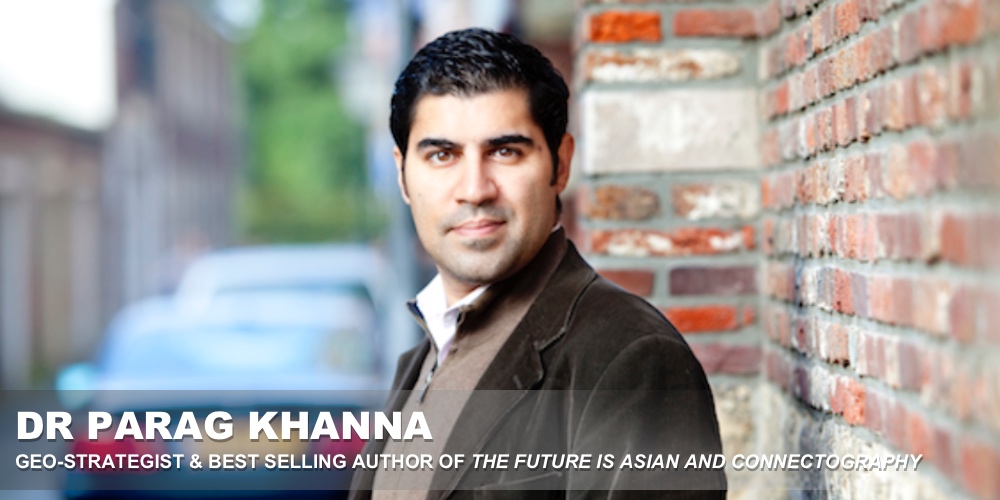
Dr Parag Khanna
|
Dr Khanna is the World’s leading geo-strategist, melding the worlds of global politics, economics, environment, and culture. He recently named one of Esquire magazine’s “75 Most Influential People of the 21st Century” and features at the top of Wired magazine’s “Smart List.” His unique analysis and scenarios provide decision-makers with a complete conceptual picture of a complex world in transition, and a roadmap to success for strategists in business, government, and civil society.
His international bestseller, The Second World: How Emerging Powers are Redefining Global Competition in the 21st Century, shatters perceptions of the world’s geopolitical and economic balance of power while uncovering the promises and challenges of today’s most important new markets. Khanna deftly portrays the new geopolitical marketplace in which the major power centers of the US, China, and Europe compete for influence in pivotal “second world” countries spread across Latin America, the Middle East, and Asia. He also elegantly warns of the risk to America of failing to rebuild its global position through innovative diplomatic and economic strategies.
Khanna’s latest book, How to Run the World; charting a course to the next Renaissance, provides bold and innovative strategies to global political and economic stability, particularly through a new “mega-diplomacy” that incorporates governments, corporations and non-government organisations (NGOs) into coalitions that transfer resources to where they are needed most. His notion of “connective leadership” is an essential approach for organisational leaders to find their place—and their essential new partners—in the new global division of labour.
Named a Young Global Leader of the World Economic Forum in 2009, Khanna has amassed a prodigious knowledge of world affairs by traveling to over 100 countries and speaking Hindi, German, French, Spanish and Arabic. He currently serves as Senior Research Fellow at the esteemed New America Foundation, where he leads the Global Governance Initiative and co-directs the Remapping the Global Economy Roundtable. Parag was recently appointed a Distinguished Visitor at the Munk School of Global Affairs at the University of Toronto. He is also a Principal of the Hybrid Reality Institute, which provides scenario analysis around emerging technology trends. Parag regularly gives executive briefings to leading corporate groups on understanding global risk and strategising for emerging markets.
A foreign policy advisor to the Barack Obama presidential campaign, he also served in 2007 as a Senior Geopolitical Advisor to U.S. Special Operations Forces in Iraq and Afghanistan. A visible voice in international media, Khanna has been featured on CNN, BBC, PBS, Al Jazeera, and NPR. As a frequent contributor to publications such as The New York Times, The Washington Post, Financial Times, Forbes, TIME, Newsweek, and BusinessWeek, he is widely sought after commentator on all aspects of the future of globalisation. Dr. Khanna holds Bachelors and Masters degrees from the School of Foreign Service at Georgetown University and a PhD from the London School of Economics.
Parag is a sought-after speaker at business summits, investment forums and top-level executive briefings around the world.
He presents on a range of topics including:
How to Run the World: Collective Leadership for a Turbulent Age
The governments of the world cannot alone solve pressing challenges from financial stability to climate change to poverty. People increasingly look to companies to shoulder the burden, while NGOs also carry a lot of weight. “Collective Leadership” is the newest approach to networked management in the complex emerging division of labour. Parag Khanna identifies the key global issues affecting everyone and what public-private partnerships are best suited to your organization to engage in and how it can result in systemic change.
The Rise of the Second World: Emerging Markets and Emerging Powers
Today’s global economic landscape features new power centers as China, India, Brazil, Turkey, Saudi Arabia and other countries flex their economic and diplomatic muscle. Parag Khanna has developed sophisticated scenarios around key emerging market regions such as the Middle East, East Asia, Central Asia and Latin America, and explains how they increasingly trade and form alliances with each other along a New Silk Road. He presents the risks and opportunities in these dynamic regions and answers which markets will become first world, and which will never emerge.
Invisible Maps: Building a Borderless World
Globalization opens up a wide range of new ways to think about and depict the emerging vectors of influence in the world, from capital flows and supply chains to demographic shifts and religious movements. Using eye-catching software that bends the lines on the world map while overlaying new pathways of power such as pipelines and railways, Parag Khanna presents a truly global tour du monde of how mega-cities, infrastructure, finance, and climate change are morphing the future of every corner of the globe.
The New Strategic Couplings
Rather than debate the extent to which fast-growing emerging markets have “de-coupled” from the sluggish West, I argue that we should explore the new trade and financial couplings that are taking shape across the world. These axes are forming among regions such as Asia-Africa and Latin America-Middle East. Not only are these emerging market regions viewing each other as sources of growth, but new strategic and diplomatic alliances are forming as well which point to what the future geopolitical order will look like.
Not State versus Market but State and Market
As governments stumble and markets tumble, citizens and investors are looking for a new set of rules that transcends antagonisms between the state and private sector. Already we see successful experiments in mixing state capitalism and free-market systems in emerging economies such as Brazil, India and others. I identify how this new division of labour is taking shape in the key power centers of the U.S., Europe and Asia, and also focus on the international level where institutions like the IMF and G-20 are defining new roles for themselves to manage global economic turbulence.
Custom-made Geo-Strategy (Tailored Briefing)
Every company today needs a global strategy for acquiring the best resources and talents at the best price and to assert themselves in the fastest growing future markets. Leveraging his unique insight gained from constant travel and building connections in the most dynamic parts of the world, Parag Khanna prepares proprietary geo-strategic guidance for your firm or industry to position itself to build a global basis for long-term growth.